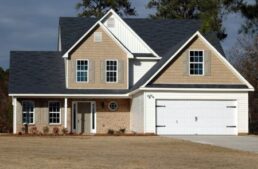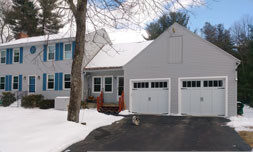
When is it Time for New Garage Doors?

We recently replaced our garage doors, and a lot of research went into our choice. Buying a new garage door isn’t something you do often. In fact, most people never buy one in their lifetime! If you’re thinking about it, this guide will walk you through everything you need to know.
Our house was built in 1987, and we’ve owned it since 1992. Around 2010, the original paint on our garage doors started to peel, showing the composite board underneath.
We painted over the peeled spots and lived with it for several years. When the doors turned 30 in 2017, we finally decided it was time for a change, and we completed the project in the spring of 2018.
So, when is it time to replace your garage doors? A good rule of thumb is to replace them when they no longer protect your garage from the weather. I’m not just talking about the weather stripping.
Replace the doors when they are so warped and old that even new weather stripping can’t keep the cold and heat out.
Should You Repair or Replace Your Garage Door?
Before you decide on a full replacement, it’s smart to think about the cost of a repair. According to leading home service resources, a typical garage door repair for common problems like a broken spring or track costs between $100 and $300.
Of course, major repairs can cost more. Before paying for a repair, ask yourself a few key questions.
Will you have a door that you like? Will it be safe and quiet?
Will it keep out the cold and heat, and will it look good? A few hundred dollars for a repaired door might be a good investment. Our doors were beyond that point, so we decided to replace them.
How Much Does a New Garage Door Cost?

Prices can change based on material, style, and where you live, but you can still make a good budget. You can expect to pay between $750 and $1,600 for a standard single garage door, and $1,600 to over $3,000 for a double door, according to recent industry reports.
These prices don’t include a new garage door opener or the cost of professional installation. These extras can add several hundred dollars to your final bill.
For a detailed breakdown of our own high-end garage door project, you can skip to the end of this article.
What Are the Best Materials for a Garage Door?

The material you pick affects how your door looks, how much work it needs, how long it lasts, and its price. Let’s look at the most common options.
Beautiful (But Pricey) Wood Garage Doors
Wood doors often look the best at first, but be ready for the work needed to keep them looking great. High-end wood doors can cost over $4,000 each and require re-staining every couple of years.
Wood doors can rot, get scratched, and warp over time. They also expand and contract with temperature changes. They are not great insulators and can catch fire easily.
Cheaper wood doors are available, but they lose their luxury look while still having all the problems of wood.
What About Aluminum Garage Doors?
Aluminum doors are cheaper than wood and won’t rot or warp. However, they dent easily and don’t insulate well.
In hot weather, aluminum doors soak up heat and transfer it right into your garage, which makes your home’s air conditioner work harder. They are also a poor choice for coastal areas because salt spray can void the warranty.
Why Insulated Steel Doors Are a Great Choice
Steel doors are a great choice for most homes. They don’t need painting, won’t warp or rot, and cost less than good wood doors.
While thin steel can dent, thicker steel is very tough. Most importantly, insulated steel doors, made with foam between two steel panels, are excellent at keeping your garage temperature stable.
Modern steel doors can look just like wood, giving you a beautiful look without the hassle or fire risk of real wood.
A Quick Look at Glass, Fiberglass, and Vinyl
Glass doors can look cool but offer no insulation, privacy, or security. Fiberglass doors need a protective top coat every two years to prevent sun damage.
Vinyl is another low-maintenance option that is very durable and won’t rust or dent, but it’s not as common as steel. Overall, none of these quite match the mix of strength, insulation, and value you get from a good insulated steel door.
What is R-Value and Why Does It Matter for Your Garage?
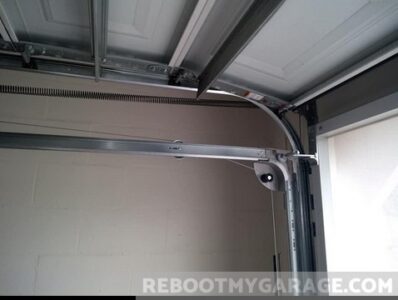
The R-value of a garage door tells you how well it stops heat from passing through. A higher R-value means better insulation. This is very important for keeping your garage at a nice temperature and saving on energy bills, especially if your garage is attached to your home.
The Clopay steel and composite Canyon Ridge door has an impressive 20.4 R-value. Their Coachman series offers R-values from 6.5 to 18.4.
Overhead Door’s R-values go up to 17.8 on their Thermacore Wind Load models. Their popular Courtyard collection has an R-value of 12.76.
C.H.I. offers doors with R-values up to 17.54 in their flush panel line. Their Overlay Carriage House doors, which we ultimately chose, have an excellent R-value of 17.92.
Torsion vs. Extension: Choosing the Safest Garage Door Springs
When it comes to doing the heavy lifting, your garage door depends on powerful springs. It’s important to know the difference between the two main types: torsion and extension.
Torsion springs are the top choice today for safety and long life. They are mounted on a bar above the door and twist to lift it, creating a smoother, more controlled motion.
While they cost more at first, torsion springs last longer (15,000-20,000 cycles) and are safer because if they break, the spring stays on the bar. We chose an upgraded high-cycle torsion system designed for 30,000 cycles.
Extension springs are an older, cheaper technology mounted along the sides of the door track. They don’t last as long (5,000-10,000 cycles) and can be dangerous if they snap without a safety cable in place.
Because the springs are under extreme tension, spring replacement is a dangerous job that you should always leave to a professional.
How to Pick the Best Garage Door Opener
Your garage door dealer will help you pick an opener with the right amount of power for your new door. When we bought ours, we could choose between a LiftMaster with Wi-Fi and one without. We chose the old-fashioned model, but I didn’t realize then how useful a smart garage could be.
We did get an exterior keypad, which we love for creating guest access codes for dog sitters.
The opener unit near the ceiling has a built-in light that we can control from the wall panel. It’s so convenient that it has become our main garage light.
Most importantly, any garage door opener sold today includes motion sensors. These safety beams tell the door to stop and go back up if anything crosses the opening. This feature saved my cat’s life on the very first day.
How Long Do Garage Doors Last (And What About the Warranty)?
You can expect a new garage door to last between 15 and 30 years, and top companies back this up. Besides the door itself, the opener and springs have their own lifespans.
A good garage door opener should last 10 to 15 years. Garage door springs wear out based on how much you use them. As experts point out, using your door frequently can shorten a spring’s life from over a decade to just a few years.
The length of a warranty is often a big clue about a product’s quality. Wood doors from major brands like Clopay and Overhead Door usually come with only a 1-year warranty.
Aluminum door warranties are a little better at one to three years. However, high-quality steel doors tell a different story.
Our C.H.I. steel door came with a limited lifetime warranty against rust. This peace of mind was a huge factor in our final decision.
How to Design the Perfect Garage Door for Your Home

One of the most fun parts of shopping for a door was using online design tools to see how different styles would look on our house. I used the C.H.I. website’s garage door visualizer to upload a photo of my house and try out different options.
This tool let me see exactly how new doors would look on my house, which made deciding so much easier.
Our house is light gray, and we realized that trying to match the exact color would be impossible because paint fades differently. We chose a bright white steel door, a classic look that our installer agreed you can’t go wrong with.
Another thing we had to think about was an extra-tall pickup truck we were considering buying. Our standard-height garage opening was too short. So, we decided to have the header raised during the replacement to make sure our garage would be ready for a future truck.
Case Study: Our C.H.I. Steel Door Installation & Cost Breakdown

After looking at all our options, we narrowed it down to two brands: Haas and C.H.I. We got a quote for the Haas American Traditions door (Model 921), which had an R-value of 13.45.
We also liked the very similar C.H.I. 5800 Steel Overlay Carriage House door. It had a better R-value of 17.92 and the option to upgrade the springs to last for 30,000 cycles.
The C.H.I. doors cost about 10% more than the Haas ones, a difference of $5274 versus $5774. For the extra money, we got better insulation, upgraded springs, and powder-coated rails for long-lasting durability.
The job included two 9×8 ft. doors, hardware, two 3/4 HP openers, remotes, and removal of our old doors. The cost for each door and installation was $2,222, and each opener was $415.
The “Lifetime Package” with upgraded hardware and springs was another $500, bringing our garage door total to $5,774. The separate carpentry work to raise the garage door openings cost an additional $1,300.
Beyond the Door: Is a Garage Screen Right for You?
I never would have thought to add a screen to the garage entrance, but now that I’ve seen it, I want one! Lifestyle sells a fully retractable screen that works with your existing garage door.
You can have either the main door or the screen down. The screen even has its own walk-through door and is hard to see through from the outside for privacy.
If you love the Lifestyle screen but not the price, you can find a really nice magnetic or zippered garage door screen for much less.
It doesn’t go up and down like the main garage door, but it costs much less. This type of screen covers the entire opening and zips or magnetically seals shut, turning your garage into a breezy, bug-free space.
Frequently Asked Questions for Garage Door Buyers
What’s the best smart garage door controller? While there are many great options out there, like those reviewed by PCMag, my research led me to the Xlive Pro Smart Video Garage Controller.
It’s compatible with almost any opener because it doesn’t use wires. It uses a small mechanical finger to push the button on your wall, so it works with any system that has a wall button.
The other reason I like it is its built-in camera, which works like a video doorbell. When it detects motion, it starts a live video session on your phone, letting you see and talk with anyone in your garage.
It has the security features I want in a smart garage controller, making it the one I plan to get.